What the tape measure says
The floor it needs when a drawer is open
An open drawer comes out about 35 cm, so leave that much clear floor in front. The last third of the drawer stays inside the unit.
A couple more room tipsListed size: 36 cm wide, 58 cm deep, 70 cm tall. Drawer inside depth 52 cm, of which about two thirds comes out.
What the listing does not say
The last third stays inside.
Thirty-six centimetres wide and 58 cm deep, the ALEX drawer unit is a tall narrow column, not a chest. That footprint is why it gets bought: it stands in for a desk leg at one end of a top, it drops into the gap beside a bed, and it fits under a window where a wider unit will not. The back is finished, so it can also stand in the middle of a room instead of against a wall.
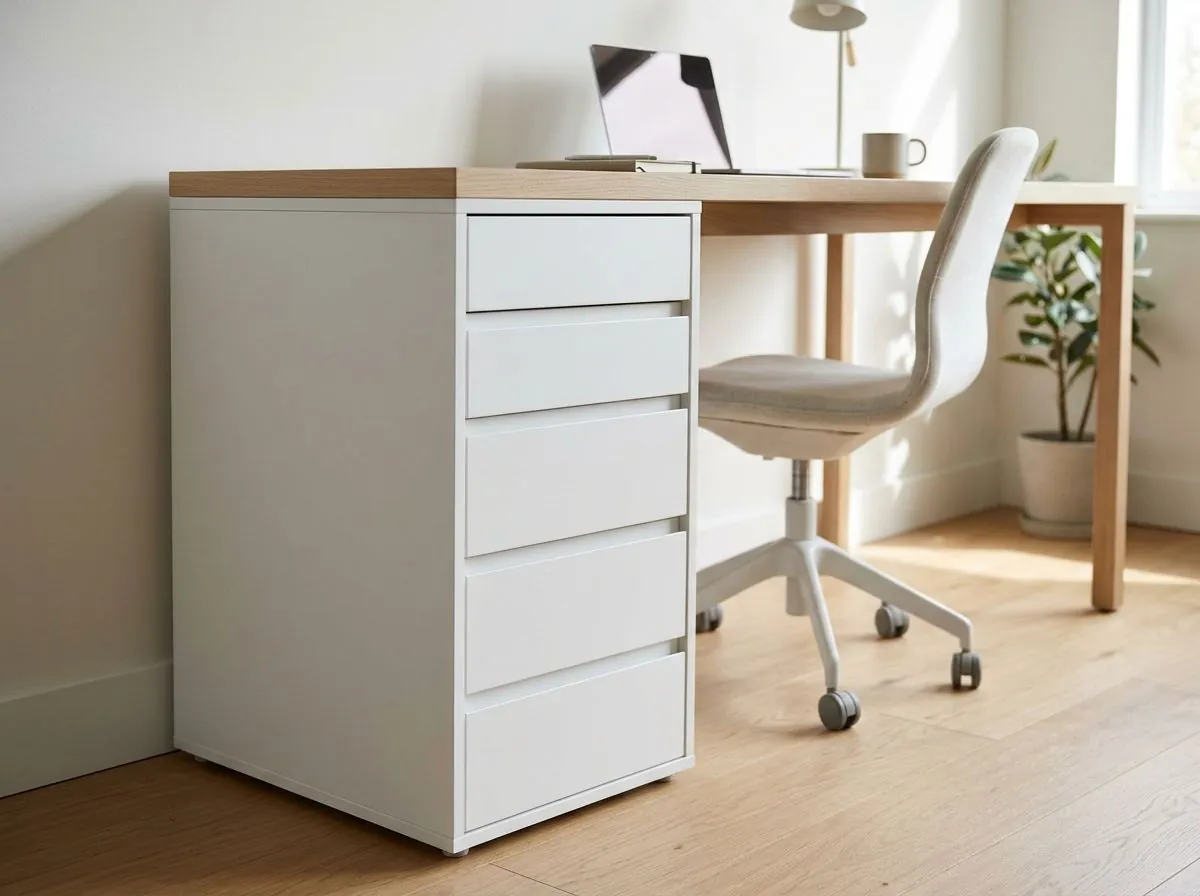
Five drawers, and they are not the same size. The top front is shallow at about 7 cm, while the four below are deeper at about 13 cm, on a drawer box of roughly 33 by 56 cm. That sits inside a case 58 cm deep with 52 cm of drawer, which sounds generous until you open one.
The drawers stop at about two thirds of their travel. That leaves roughly 15 cm at the back of every drawer that you cannot reach without lifting the drawer out, and owners describe things sliding into that gap as the drawer is pulled. It is a deliberate stop rather than a fault, and the usual workaround is to keep the back third for what you rarely need: spare labels, old paperwork, a second pair of scissors.
The load rating is the number that surprises people. The listing gives 12 kg for the whole unit, 4 kg per drawer and 2 kg for the small top drawer. Under a desk that rating covers the weight of the top resting on it, not a drawer packed with paper. Weigh a full drawer of A4 before you decide this is a filing cabinet.
Runners are the other split in owner reports. Some units open smoothly and quietly, while others feel gritty, like sand, and need a firm push to close flush. Over-tightening the screws during assembly is the cause most often named, and the listing itself says to re-tighten the screws about two weeks after assembly. A front that sits off kilter usually means the drawer was never screwed to its runner from the inside.
As a desk leg, height is the catch. At 70 cm the unit sits below a standard desk, so owners add wheels, risers or a thicker top to make up the difference, and the plastic bumpers in the box are there to stop the top sliding. The unit is heavy enough to feel solid once it is loaded, and the white finish chips at the edges, so lift it rather than drag it when you rearrange the room.
Wipe with a cloth dampened in a mild cleaner and dry it with a clean cloth, as the listing says. Re-tighten the screws about two weeks after assembly, and check the runner screws if a drawer starts to feel stiff.